
New Delhi, 14 February 2026
By Tannaz Ahmed and Tushar Gandhi
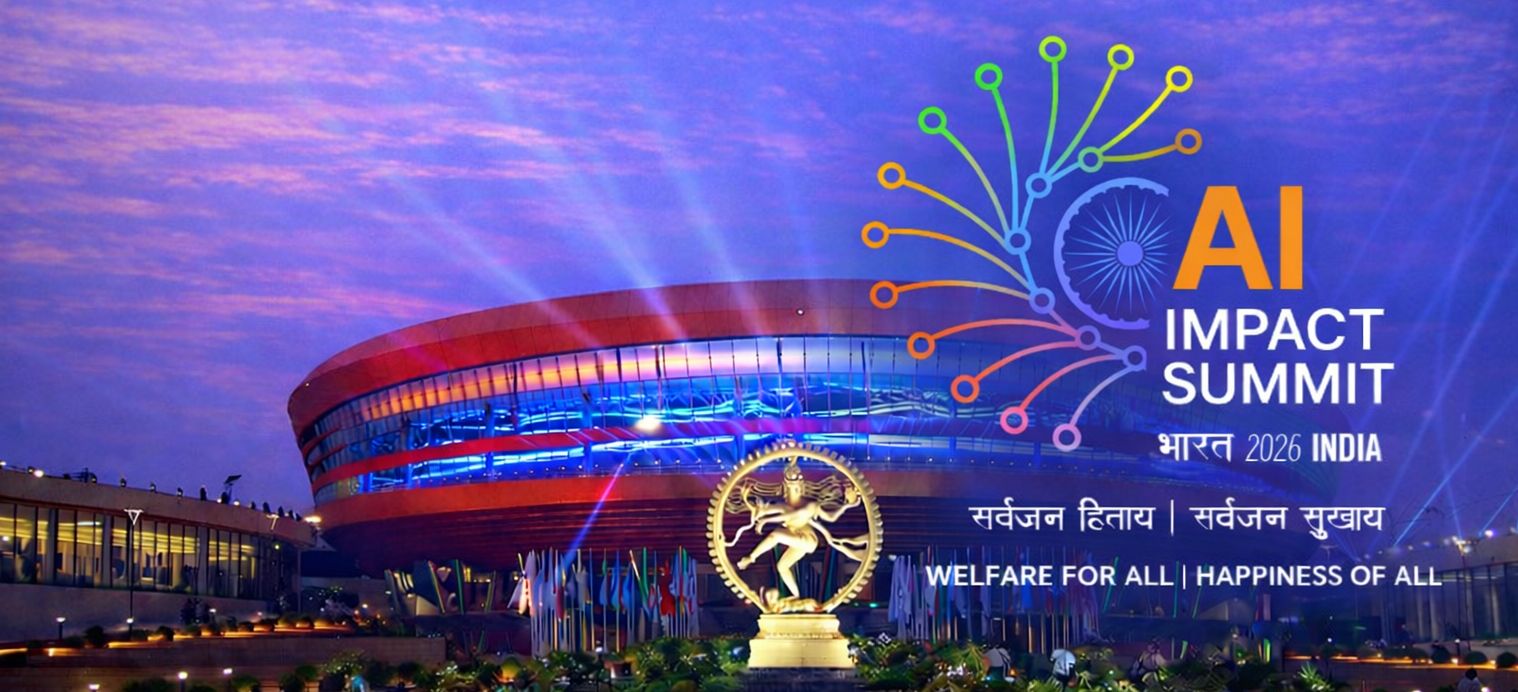
The upcoming India AI Impact Summit 2026 is emerging as one of the most important global technology gatherings of the year. Positioned at the intersection of geopolitics, innovation and governance, the summit reflects India’s growing ambition to shape the next phase of global artificial intelligence policy and deployment.
Beyond its scale, the summit’s significance lies in its attempt to bridge advanced AI economies with emerging markets, placing India at the center of an evolving, multi-polar AI ecosystem.
Scale and Global Participation
The summit is expected to draw participation from more than 100 countries, alongside over 100 global CEOs, policymakers, researchers and investors. Registrations have reportedly crossed 35,000, underscoring the high level of global interest.
Prime Minister Narendra Modi is set to inaugurate the summit, signalling strong political ownership. Confirmed or widely expected heads of state and senior leaders include:
- President Emmanuel Macron (France)
- President Luiz Inácio Lula da Silva (Brazil)
- UN Secretary-General António Guterres
The United States delegation will be led by Michael Kratsios, Assistant to the U.S. President and Director of the White House Office of Science and Technology Policy (OSTP). China is expected to participate through a senior government and AI research delegation, adding a notable dimension to regional and global technology diplomacy.
Additional high-level representation is anticipated from countries across Europe, Asia, Africa and the Global South, reinforcing the summit’s positioning as a broad multilateral platform.
Corporate Leadership and Technology Representation
The summit is also expected to convene the most influential leaders in global AI and digital infrastructure, including:
- Sam Altman (OpenAI)
- Jensen Huang (NVIDIA)
- Sundar Pichai (Google & Alphabet)
- Alexandr Wang (Scale AI)
- Demis Hassabis (Google DeepMind)
- Dario Amodei (Anthropic)
- Julie Sweet (Accenture)
- Cristiano Amon (Qualcomm)
- Nikesh Arora (Palo Alto Networks)
- Matthew Prince (Cloudflare)
Strong domestic industry participation is expected from leaders such as Mukesh Ambani, Nandan Nilekani, and Sunil Bharti Mittal, reflecting India’s private sector engagement across telecom, digital infrastructure and enterprise technology.
The presence of leading AI model developers, chip manufacturers, cybersecurity firms, and cloud providers signals that discussions will extend beyond policy frameworks to infrastructure, compute access, and commercial deployment.
Expo and Ecosystem Participation
The India AI Impact Expo component is expected to feature over 400 exhibitors, spanning AI infrastructure providers, enterprise solution companies, research institutions and startups.
This positions the summit not only as a diplomatic and policy dialogue platform, but also as a commercial showcase for:
- Foundational and domain-specific AI models
- Data center and compute infrastructure
- AI applications in health, agriculture, finance and governance
- Startup innovation from India and emerging markets
Emerging Policy Themes and Collaboration Tracks
Beyond keynote speeches and CEO roundtables, the summit’s working sessions are expected to focus on structural questions shaping the global AI ecosystem:
1. AI Infrastructure Cooperation
Discussions are anticipated around compute collaboration, semiconductor supply chains, and data center investments particularly in the context of reducing supply-chain concentration risks.
2. Responsible and Safe AI Standards
Countries are expected to explore common minimum standards for safety, transparency, and accountability in AI deployment, with particular emphasis on inclusive and human-centric approaches.
3. Workforce and Skilling Partnerships
Joint initiatives on AI education, digital skilling and research exchanges are likely to form part of bilateral and multilateral discussions.
4. Global South Cooperation
A prominent thread is expected to center on inclusive AI frameworks tailored to emerging economies, positioning India as a convenor for Global South engagement in AI governance.
Several bilateral meetings on the sidelines are expected to result in Memoranda of Understandings (MoUs) or framework agreements in areas such as AI infrastructure, education, research collaboration and innovation partnerships.
Strategic Positioning: Beyond a Conference
The summit reflects a broader strategic calculation: AI governance is increasingly shaped through coalitions rather than singular blocs. By convening Western economies, emerging markets, and major AI corporations under one platform, India is positioning itself as a bridge actor in a fragmented global technology landscape.
The presence of both U.S. and Chinese delegations, alongside European and Global South leaders, underscores the summit’s geopolitical dimension. It is positioned not merely a technology forum, but where standards, partnerships and long-term take shape.
Overall Assessment
The India AI Impact Summit 2026 signals India’s intention to move from being a large AI market to becoming a central node in global AI governance and deployment.
Its success, however, will be measured less by attendance figures and more by tangible outcomes:
- Durable partnerships on AI infrastructure
- Alignment on responsible AI standards
- Concrete skilling and research collaborations
- A clearer roadmap for inclusive AI growth
If effectively executed, the summit could mark a shift toward a more distributed and coalition-based AI order, one in which India plays a defining role in shaping both the rules and the applications of the next technological era.