
- States – 28
- UTs – 8
- GDP – 2.62 lakh crores USD (2020, World Bank)
- Growth – 8.2 percent (FY23, IMF)
- Population – 138 crores (2020, World Bank)
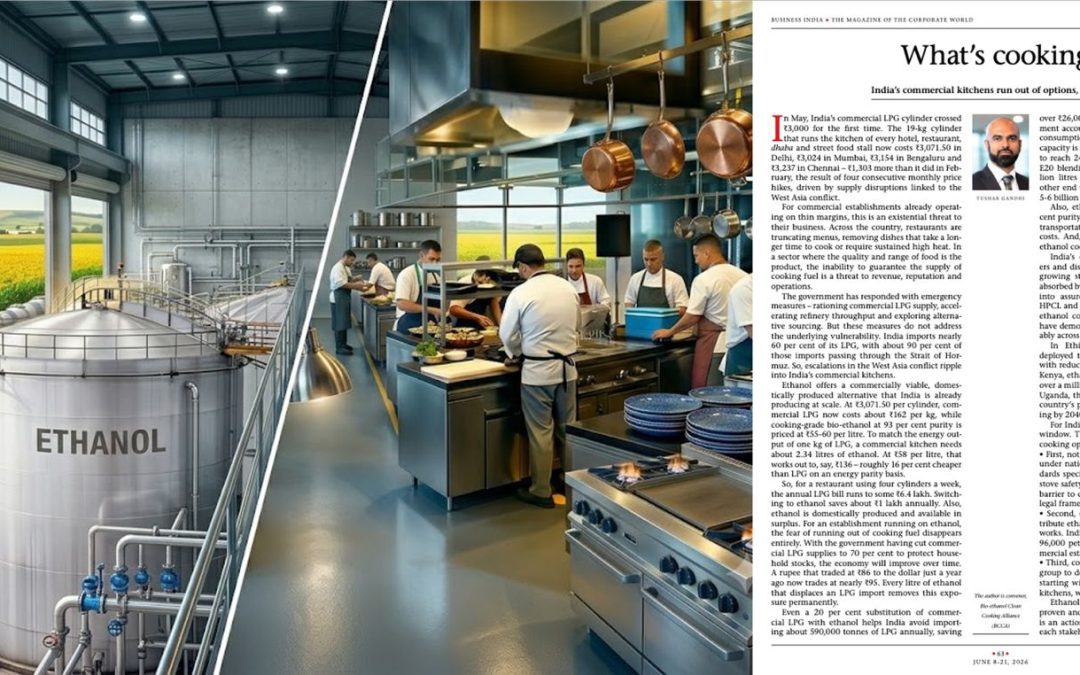
India’s Commercial Kitchens Are Running Out of Options, Not Just Gas
New Delhi, 24 June 2026
By Tushar Gandhi
In May, India’s commercial LPG cylinder crossed Rs 3,000 for the first time. The 19-kg cylinder that runs the kitchen of every hotel, restaurant, dhaba, and street food stall now costs Rs 3,071.50 in Delhi, Rs 3,024 in Mumbai, Rs 3,154 in Bengaluru, and Rs 3,237 in Chennai. That is Rs 1,303 more than it did in February, the result of four consecutive monthly price hikes driven by supply disruptions linked to the West Asia conflict. For commercial establishments already operating on thin margins, this is not a passing inconvenience. It is an existential threat to their business.
Across the country, restaurants are truncating menus, removing dishes that take longer to cook or require sustained high heat. Hotels are unable to serve certain items entirely. In a sector where the quality and range of food is the product, the inability to guarantee supply of cooking fuel is a direct threat to revenue, reputation, and operations.
The government has responded with emergency measures – rationing commercial LPG supply, accelerating refinery throughput, and exploring alternative sourcing. While these are the right short-term responses, they do not address the underlying vulnerability. India imports nearly 60% of its LPG, with approximately 90% of those imports passing through the Strait of Hormuz. Every escalation in West Asia will ripple directly into India’s commercial kitchens.
Ethanol offers a commercially viable, domestically produced alternative that India is already producing at scale.
At Rs 3,071.50 per cylinder, commercial LPG now costs approximately Rs 162 per kg. Cooking-grade bioethanol at 93% purity is currently priced at Rs 55 to 60 per litre. To match the energy output of one kg of LPG, a commercial kitchen needs approximately 2.34 litres of ethanol. At Rs 58 per litre, that works out to approximately Rs 136, roughly 16% cheaper than LPG on an energy parity basis.
That 16% saving matters. For a restaurant using four cylinders a week, the annual LPG bill runs to approximately Rs 6.4 lakh. Switching to ethanol saves approximately Rs 1 lakh annually.
But cost is only part of the argument. Ethanol is domestically produced and available in surplus. A commercial establishment running on ethanol does not face the supply uncertainty that is currently forcing restaurants to turn away customers and shorten menus. The fear of running out of cooking fuel disappears entirely. With the government having already cut commercial LPG supplies to 70% to protect household stocks, this fear is the daily reality for commercial kitchens today.
The economics will only improve over time. A rupee that traded at Rs 86 to the dollar just a year ago now trades at nearly Rs 95, a depreciation of over 10% in twelve months alone. Every litre of ethanol that displaces an LPG import removes this exposure permanently.
At 20% substitution of commercial LPG with ethanol, India avoids importing approximately 590 thousand metric tonnes of LPG annually, saving over Rs 26,000 crore in foreign exchange from a segment accounting for just 9.4% of total LPG consumption.
India’s installed ethanol production capacity is 2,100 crore litres annually and is expected to reach 2,400 crore litres by the end of 2026. The E20 blending programme absorbs approximately 1,050 crore litres per year. Even accounting for all the other end uses like industrial and potable, there is surplus capacity of 500 to 600 crore litres, enough to serve millions of commercial establishments across the country.
Another advantage is that ethanol for cooking requires only 93% purity, compared to 99.5% required for transportation fuel blending, reducing production costs. The supply infrastructure for ethanol cooking exists today, without the need for additional investment, research, or time.
The benefits extend beyond commercial kitchens. India’s ethanol surplus is produced by farmers and distilleries across sugarcane and grain-growing states. Every additional litre of ethanol absorbed by the cooking segment translates directly into assured procurement demand for farmers, supporting rural incomes.
Ethanol cooking is not a new concept, and its viability is not untested. HPCL and IIT Guwahati have jointly developed an ethanol cookstove, and pilots conducted in India have demonstrated that the technology works reliably across diverse conditions.
Globally, the evidence is extensive. In Ethiopia, ethanol cookstoves have been deployed to thousands of households over more than a decade, with validated reductions in particulate matter emissions. In Kenya, pay-as-you-go ethanol distribution networks have reached over a million households across multiple cities at commercial scale. In Uganda, the government expects the majority of the country to be using ethanol for cooking by 2040.
India’s opportunity is structurally stronger than any of these markets, with surplus, existing distribution infrastructure, and a government mandate to reduce import dependence.
The current crisis has created a policy window. Three actions would unlock the ethanol cooking opportunity at commercial scale.
First, formally notify ethanol as an approved cooking fuel under national energy frameworks, with BIS standards specifying the 93% purity grade and stove safety requirements. This single regulatory action removes the largest barrier to commercial adoption, the absence of a legal framework for ethanol as a cooking fuel.
Second, enable oil marketing companies, HPCL, IOCL, and BPCL, to distribute ethanol through their existing commercial LPG networks. India has over 25,000 LPG distributors and 96,000 petrol retail outlets that already reach every commercial establishment in the country.
Third, constitute a government-industry working group to develop a structured commercial rollout framework, starting with hotels, restaurants, and institutional kitchens in cities where commercial LPG consumption is highest.
Ethanol is domestically produced, technically proven, and commercially viable today. India does not need another study. It needs a clear action plan with defined responsibilities for each stakeholder — government, OMCs, distilleries, and stove manufacturers