by | Aug 9, 2026 | Archive
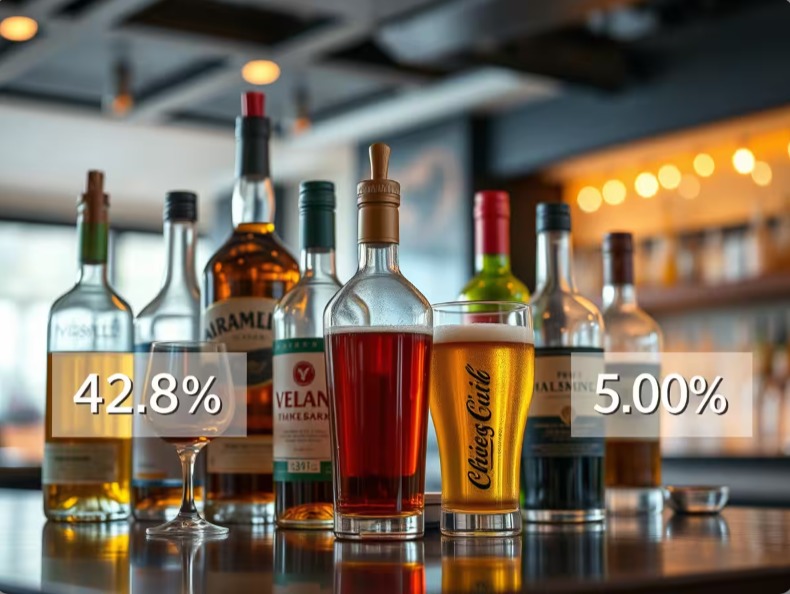
Karnataka’s alcohol tax reform links excise duty to pure alcohol content, aiming to reduce harmful drinking while protecting state revenue.

by Zen Webnet | Dec 20, 2024 | Archive
‘Just one more drink!’ – a familiar phrase at every party. But when my friend and I sat down with a bottle of red wine one Sunday evening, we questioned what ‘one drink’ really means, and deliberated whether consuming the entire bottle would be excessive for the two of us. Our curiosity led us to uncover some eye-opening facts about the actual alcohol content within the bottle of wine, thereby enabling us to make a well-informed comparison with other alcoholic beverages such as beer and spirits.

by Zen Webnet | Nov 3, 2023 | Archive
In the light of a recent government decision to set up a committee whether higher taxes can be reduced to promote beer that has low pure spirit content than hard liquors, a study paper ‘Policy measures to reduce per capita consumption of alcohol in India’ brought out by Consumer Voice & Gateway Consulting has recommended uniform taxation based on pure spirit content (or alcohol by volume) instead of separate taxation for different alcohol types. It may be mentioned here that several European and southeast Asian countries besides the US have policies to promote wine and beer over hard liquors. In India, Haryana (Gurugram) is the only state that has taxation based on alcohol by volume (ABV) and hence is the cheapest in the country.

by Zen Webnet | Apr 24, 2023 | Archive
As India’s per capita consumption of doubles, a consumers’ outfit on Thursday urged the state governments to correct their taxation policies to discourage the intake of “hard liquor” like whiskey, rum, vodka and gin while waving red flags on the growing tendency of binge drinking among youngsters and adverse social and health consequences of such a habit.
Between 2005 and 2016, India’s per capita consumption of pure alcohol shot up from 2.4 litres to 5.7 litres with a sharp rise in demand for whiskey, vodka, rum, gin, India-made foreign liquor and country liquor, as against soft liquor like beer and wine.
No safe limit of alcohol consumption for health, shows WHO analysis

by Zen Webnet | Feb 20, 2023 | Archive
Consumer VOICE , a Voluntary Action Group of Academicians, Professionals and Volunteers, working to raise awareness amongst Indian consumers about their rights, has demanded that the government should involve health authorities and formulae a central level policy to moderate consumption of liquor in India, which incidentally has seen a steep hike in the past few years, specially among the youth.
As per an Indian Council for Research on International Economic Relations (ICRIER) and PLR report in 2016, India’s average per capita consumption was the highest in the world at 13.5 litres of pure alcohol from hard liquor (whiskey, vodka, rum, gin, IMFLs and country liquor) in comparison to just 1.1 litres of pure alcohol from beer.
However, in most other countries, beer consumption was far higher than hard liquor. In Australia, it was 5.3 litres vs 1.7 litres; in Brazil, it was 11.9 and 6.6 litres; in Canada, it was 6.2 and 3.6 litres and in the USA, it was 6.4 and 4.8 litres.
Pure alcohol is the actual alcohol content, which varies across beverages. For instance, in mild beer (650 ml)— 32.5 ml of pure alcohol is used while in red/white wine (750 ml)—97.5 ml of pure alcohol and 321 ml of pure alcohol is used in IMFL (750 ml bottle of whiskey, vodka, gin, rum etc).
