
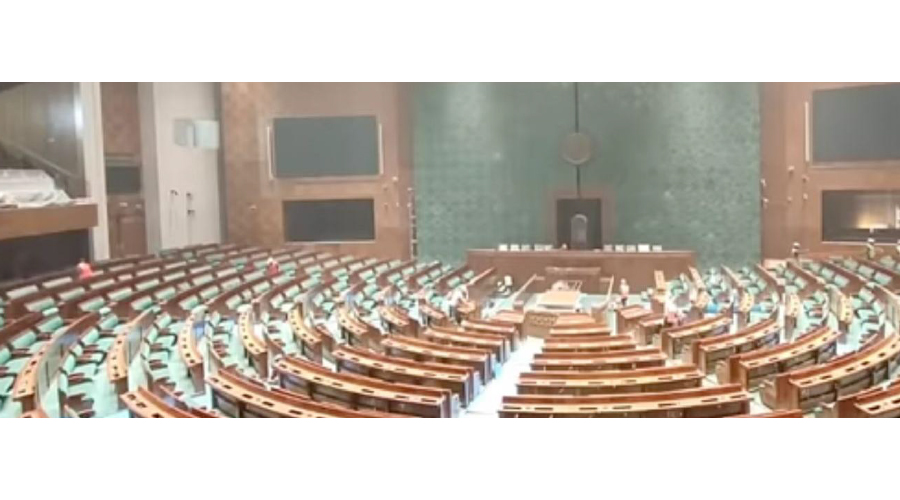
India’s Parliament concluded its Winter Session on 19 December, after sitting for 15 days between 1 and 19 December. Ten government bills were introduced, of which eight were passed by both Houses across sectors including energy, insurance, rural employment and public finance.
While the overall legislative volume was limited, the session focussed on addressing policy frameworks that needed reworking of institutional structures, to achieve their higher potentials.
Two legislations — the SHANTI Bill and the VB-G RAM-G Bill — were particularly significant, not because they introduce entirely new policy areas, but because they reset the design of existing frameworks that have shaped investment and programme delivery.
SHANTI Bill: Updating India’s Civil Nuclear Framework
The Sustainable Harnessing and Advancement of Nuclear Energy for Transforming India (SHANTI) Bill, 2025 marked a legislative shift in India’s civil nuclear architecture since the sector was opened to international cooperation in the late 2000s.
The Bill provides a basis for private and joint-venture participation across segments such as reactor construction, operations, maintenance and supporting infrastructure. At the same time, it retains government control over regulation, safety and licensing, reflecting the strategic nature of the sector.
Importantly, the legislation recognises the importance of private sector participation to support India’s nuclear expansion ambitions. Provisions related to long-term power offtake arrangements and clearer allocation of operational responsibility are intended to improve project viability and attract non-public capital.
The Bill also aims to increase the role of state governments, particularly in areas such as land acquisition, local clearances and grid integration — reinforcing the importance of centre–state coordination in large energy projects.
VB-G RAM-G Bill: A Redesign of Rural Employment Policy
The VB-G RAM-G Bill, 2025, which replaces the Mahatma Gandhi National Rural Employment Guarantee Act (MGNREGA), represents the first redesign of India’s rural employment guarantee framework since the programme’s inception. The new bill aims to modernise rural employment, whereby it will integrate job allocation with digital governance platforms, improve efficiency, transparency, and alignment with national infrastructure projects, potentially creating a digitally connected rural workforce.
However, the scheme also raises some concerns where marginalized workers without access to smartphones, Aadhaar-linked bank accounts, or digital literacy could be excluded, undermining the scheme’s inclusivity.
While the Bill raises the guaranteed employment ceiling to 125 days, its more consequential change lies in how employment is structured and delivered. States are given greater flexibility to define permissible works, enabling closer alignment with local infrastructure needs, climate adaptation priorities and asset creation goals.
The legislation also places stronger emphasis on digital attendance, work verification and outcome-based monitoring, shifting the programme toward a more execution-driven model. This increases the administrative role of state governments, while also placing greater accountability on implementation capacity at local levels.
Insurance Sector Reform: Improving Capital Availability
Parliament also approved amendments raising the FDI cap in insurance to 100 percent. While incremental, the change aims at improving capital availability, product depth and coverage expansion, particularly in under-served segments such as health and risk insurance.
In addition to the headline reforms, the Parliament also cleared a set of legislations that underpin fiscal management, taxation and regulatory housekeeping. The Appropriation (No. 4) Bill, 2025 authorised withdrawals from the Consolidated Fund of India to meet ongoing government expenditure, ensuring continuity of programmes. The Manipur Goods and Services Tax (Second Amendment) Bill, 2025 aligned the state’s GST framework with decisions of the GST Council, focusing on classification clarity and compliance simplification. Amendments to the Central Excise law sought to rationalise duty structures and reduce interpretational disputes, with the stated objective of improving transparency and easing compliance for industry. The Parliament also passed the Health Security se National Security Cess Bill, 2025, creating a dedicated cess to support public health preparedness and national security expenditure. The Repealing and Amending Bill, 2025 removed obsolete statutes and corrected inconsistencies across existing laws, continuing the process of legislative clean-up.
What the Session Did Not Address
Equally notable were the areas that remained outside the session’s legislative agenda. There were no major reforms in digital regulation, competition law or climate legislation. This selective approach reinforces the view that current policy efforts are focused on execution and restructuring, rather than introducing new laws.
Overall Assessment
The Winter Session reflects a measured policy approach, revisiting legacy frameworks which needed reworking rather than incremental changes.
For stakeholders involved in infrastructure delivery, long-term investment, programme implementation and regulatory compliance, the session provides early signals on where policy attention is likely to remain concentrated. As these laws move into the rule-making and implementation phase, outcomes will depend on centre–state coordination, administrative capacity and regulatory clarity rather than legislative intent alone.