
By Tushar Gandhi and Anjali Batra
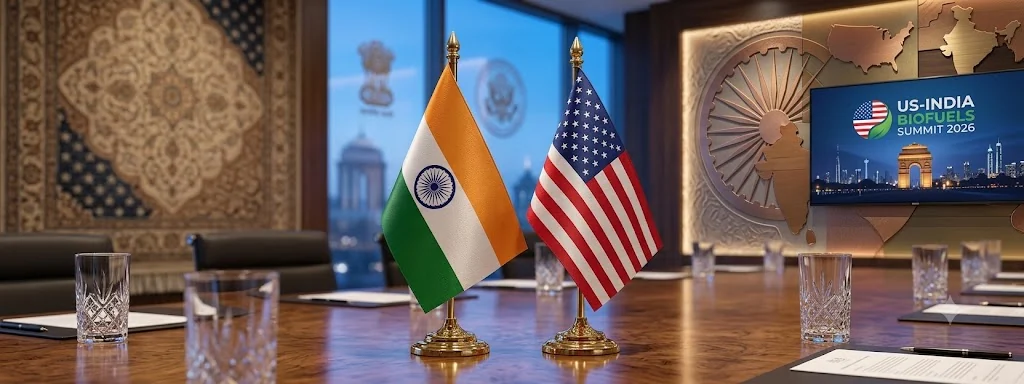
On 22 September 2026, the U.S. Grains & BioProducts Council (USGBC) and the U.S.-India Strategic Partnership Forum (USISPF) convened the U.S.-India Biofuels Summit 2026 in New Delhi. Building on earlier discussions around ethanol blending and feedstock diversification, the summit placed biofuels within a wider policy frame of energy security, rural value creation, industrial competitiveness, and hard-to-abate decarbonisation. India’s ethanol ecosystem is now being assessed not only by its ability to meet fuel blending targets but also by its capacity to support the country’s wider energy needs in sectors such as aviation, clean cooking, and maritime operations. Taking the discussion forward from its inaugural edition in 2024, which identified applications in sustainable aviation fuel (SAF) and clean cooking, this year’s dialogue focused on bringing stakeholders together to discuss implementation roadmaps.
India’s Ethanol Blending Programme (EBP) has created the underlying production, storage, and distribution foundation for this next phase. Blending rates surged from a modest 0.6 percent in 2012–13 to 10 percent in 2022, culminating in the nationwide rollout and consistent 20 percent blending (E20) by 2026. Backing this transformation is an installed distillation capacity of 24 billion litres, producing nearly 20 billion litres of ethanol annually. With E20 fuel blending absorbing approximately 12 to 13 billion litres, India now possesses a domestic surplus for other applications. The policy challenge is therefore shifting from building capacity to directing available resources towards applications that provide the greatest combination of energy security and carbon emission reductions.
Beyond surface transport, SAF emerged as a central pillar of the summit’s agenda. India is currently the world’s third-largest domestic aviation market, with fleet and passenger traffic expected to roughly quadruple by 2040. As international aviation faces progressively stronger carbon-accounting and fuel-intensity requirements, SAF is becoming a strategic issue for airlines, refiners, airports, and fuel suppliers rather than a niche climate intervention. To meet impending decarbonisation mandates, India is uniquely positioned to pursue the Alcohol-to-Jet (ATJ) pathway, capitalising on its domestic ethanol surplus. Representatives from the aviation industry at the summit showcased significant technical milestones, including recent successful SAF demonstration flights conducted with Indian carriers and research institutions. However, bridging the capital expenditure hurdle—with a domestic ATJ facility requiring around ₹3,500 crore—and aligning with international carbon-accounting standards will be vital to making commercial SAF supply cost-competitive by the end of the decade.
Building on these themes, a dedicated panel co-convened by the Global Biofuels Alliance (GBA) focused on the alternative and viable utilisation of surplus domestic ethanol as an immediate, transformative opportunity in the clean cooking segment. With volatile international energy markets continuing to disrupt imported commercial LPG supplies, ethanol provides a reliable, domestically refined solution. Global deployment models, particularly across East Africa, successfully demonstrated the commercial appeal of this fuel. In countries like Kenya and Uganda, early ethanol distribution networks rapidly scaled to over a million households by offering a clean alternative up to 40 percent cheaper than traditional charcoal.
India’s superior distillery infrastructure and extensive oil marketing distribution reach give it a structural advantage to implement bioethanol cooking on a national scale. Transitioning commercial kitchens, street vendors, and institutional canteens to ethanol insulates businesses from import shocks. Furthermore, creating a fuel-agnostic clean cooking policy framework would unlock affordable clean cooking for low-income and migrant households while generating assured demand for domestic farmers.
The summit also turned its attention to a new frontier – Sustainable Marine Fuel. The International Maritime Organization (IMO) has introduced its Net-Zero Framework, mandating stringent Greenhouse Gas Fuel Intensity benchmarks for large vessels starting in the coming years. With alternative fuels currently making up barely 2 percent of the global marine mix, ethanol is emerging as a practical, high-volume alternative to help ship operators comply with international emission norms. Backed by significant funding allocations under the Maritime India Vision 2030 and Amrit Kaal Vision 2047, India has an opportunity to develop green bunkering and alternative fuel logistics across its primary ports.
Ultimately, the U.S.-India Biofuels Summit 2026 underscored that India has moved past the stage of proving whether ethanol works. With world-class distillation capacity in place and proven technology across aviation, cooking, and marine transport, the focus now pivots to decisive policy execution. By formalising regulatory frameworks and enabling cross-sectoral adoption, India is well-positioned to accelerate its transition into a global clean energy powerhouse.