
by Zen Webnet | Nov 10, 2026 | In the news
New Delhi, 10 November 2026
By Tushar Gandhi and Anjali Batra
The India-New Zealand Free Trade Agreement (FTA) is India’s first trade pact with New Zealand and part of a broader effort to deepen engagement across the Indo-Pacific. Talks launched on 16 March 2025 and concluded on 22 December 2025, making this one of India’s fastest negotiations with a developed economy. Commerce and Industry Minister Piyush Goyal and New Zealand’s Trade and Investment Minister Todd McClay signed the agreement in New Delhi on 27 April 2026, and it entered into force on 20 October 2026.
Under the agreement, New Zealand removes 100% tariffs on Indian exports. Alongside, as part of the FTA, New Zealand also introduces US$ 20 billion FDI into India and eases mobility pathways and work opportunities for Indian professionals and students.
India’s Market Access Offer for New Zealand
India has opened access to New Zealand imports on 70.03% of tariff lines, covering about 95% of current bilateral trade by value, while protecting sensitive domestic sectors including dairy, sugar and select agricultural products. The offer is structured in four parts:
- 30% Immediate Duty Elimination – Applicable to goods including wood, wool, sheep meat and raw hides.
- 35.60% Phased Reduction – Phased out over 3,5,7, and 10 years. Includes goods such as petroleum oil, vegetable oils, and selected machinery. The immediate group is weighted towards inputs such as wooden logs, coking coal and metal scrap, which Indian manufacturers buy.
- 4.37% Duty Reductions – Offers partial/reduced tariffs across products like wine, pharmaceuticals, polymers, aluminium, iron, steel etc.
- 0.06% Tariff Rate Quotas (TRQs) – Includes select sensitive agricultural and horticultural items.
A few sensitive domestic sectors were excluded from tariff relaxation in interest of protecting millions of small producers. This includes dairy, staples such as sugar, edible oil, onion, chickpea, maize, base metals, gems, jewellery, arms, and ammunition.
What’s In It for Indian Exporters?
For Indian exporters, the agreement offers 100% duty-free access across all Indian tariff lines for export into New Zealand as opposed to 10% duties phased across a few sectors. This particularly benefits labour-intensive sectors spanning across textiles, apparel, leather, footwear, pharmaceuticals, and engineering goods.
With New Zealand’s textile and apparel market valued at around US$ 2.2 billion in 2024, compared to Indian sales of about US$ 103 million, the duty-free export presents significant room for growth. In terms of pharmaceuticals, New Zealand agreed to accept GMP and GCP inspection reports from trusted regulators like US FDA, UK MHRA, and European Medicines Agency to reduce duplicate inspections and enable faster entry of Indian generic drugs. Also, India’s US$ 136.34 million of engineering goods exports represents 0.6% of New Zealand’s total US$ 23.3 billion import market, bringing significant growth opportunities for India.
Dairy products (milk, cream, whey, yoghurt and cheese) remain excluded, as do animal products other than sheep meat. On the agricultural front, India will implement a quota system for importing apples, kiwifruit, manuka honey, and albumins from New Zealand at concessional duty rates. This framework aims to protect domestic farmers while regulating the imports. Tariff-rate quotas allow a fixed volume at a lower duty, with minimum import prices, seasonal windows and volume caps limiting entry.
Two questions will decide whether this works. The first is whether the minimum import price and seasonal windows are enforced at the border, since they protect domestic prices. The second is whether the Centres of Excellence reach growers, in the case of apples most likely in hill states such as Himachal Pradesh and Jammu and Kashmir.
The agreement addresses part of the non-tariff cost. It has dedicated sanitary and phytosanitary and technical barriers to trade chapters, electronic certification, clearance of standard cargo within 48 hours (24 hours for express and perishable goods), and acceptance of inspection reports for pharmaceuticals from comparable regulators. Exporters must also meet product-specific rules of origin to claim zero duty
Beyond trade in goods, New Zealand has provided for trade in traditional medicine, including Ayurveda and yoga, for the first time in any of its trade agreements, alongside cooperation on medical value travel and wellness services. The agreement also provides for cooperation on export readiness, trade information and linkages with New Zealand’s small-business ecosystem, with a focus on MSMEs owned by women and youth. An interim arrangement recognising organic certification took effect on day one, with a full review due in October 2027.
Mobility: Routes to Skilled Movement and Employment
The agreement creates a Temporary Employment Entry (TEE) pathway with a quota of 5,000 visas for skilled Indians, for stays of up to three years. The TEE pathway allocates the 5,000 places across sectors: 1,200 in healthcare, 1,000 in IT, 1,000 in engineering, 700 in construction, 500 in education, and 600 across occupations including chefs, Ayurveda practitioners and yoga instructors. Indian workers on temporary stays are exempted from New Zealand’s social security contributions.
The agreement also sets terms for Indian students. Indian students face no cap on numbers and can work at least 20 hours a week, a minimum written into the treaty. Graduates can remain in New Zealand to work for up to two years after a bachelor’s degree, three years after a STEM bachelor’s or master’s degree, and four years after a doctorate, with the doctoral provision applying from 16 November 2026. Up to 1,000 Indians aged 18 to 30 can also work in New Zealand each year under a working-holiday scheme due within two years.
Investment: A Promise to Promote
New Zealand’s US$ 20 billion commitment runs over 15 years, approximately US$ 1.3 billion a year. It equals approximately 4.7 per cent of New Zealand’s total overseas investment of US$ 422.6 billion as of March 2025. The release pairs the commitment with joint strategies to promote investment in renewable energy, digital services and modern infrastructure, and with a Rebalancing Clause to address any shortfall in delivery.
The clause suggests both governments expect that money may not arrive on schedule. Investment decisions are likely to sit with private firms and funds, so the pledge is best read as a target the two governments will work to meet, not a sum New Zealand has set aside. The summary does not say what the clause requires once a shortfall is identified.
What the Ministry’s Summary Does Not Address
- No estimate of jobs. The summary expects employment gains in textiles, leather and engineering but gives no figure.
- No quota volumes or minimum import prices for the TRQ products.
- No consequence if the Joint Agriculture Productivity Council finds that an action plan has not been delivered, including whether a quota can be reduced.
- No detail on what triggers the Rebalancing Clause or what it requires.
Overall Assessment
The agreement is a cautious opening. India accepts competition on inputs, on lines phased over up to ten years and on small quotas for a few farm products, and keeps dairy and other sensitive lines out. The gains most likely to arrive first are for exporters in labour-intensive sectors, where tariffs of up to 10 percent have been removed. The rebalancing mechanism gives India a lever if investment or agricultural-productivity delivery falls short, and the quota terms give New Zealand a lever if import volumes exceed agreed thresholds. This makes the commitments conditional on performance.
Exporters and MSME clusters need to prepare for rules-of-origin and certification requirements. Apple and honey growers, and the state horticulture departments that serve them, will feel the quota terms and the Council’s monitoring most directly. The Ministry of Commerce and Industry could allow independent assessment by publishing quota utilisation, visas issued and investment received.
Four figures will settle the verdict: export growth in labour-intensive sectors, Temporary Employment Entry visas actually issued, investment that lands against the US$ 20 billion, and the prices Indian apple and honey growers receive once quota imports begin.
References
- Press Information Bureau (PIB), Ministry of Commerce and Industry, “India – New Zealand Free Trade Agreement Signed”, 27 April 2026.
https://static.pib.gov.in/WriteReadData/specificdocs/documents/2026/apr/doc2026427857501.pdf
- Ministry of Foreign Affairs and Trade, New Zealand, “New Zealand-India Free Trade Agreement”. https://www.mfat.govt.nz/indiafta
by Zen Webnet | Nov 6, 2026 | In the news
New Delhi, 06 November 2026
By Anjali Batra
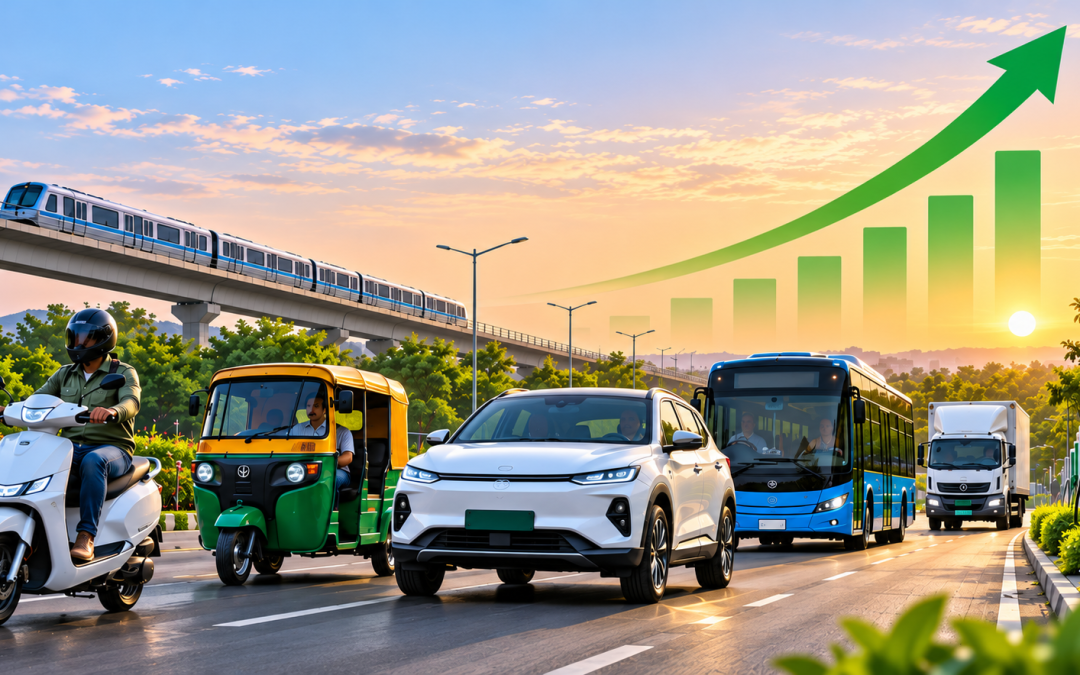
In September 2026, India sold 3.33 lakh electric vehicles (EVs), an increase of 74% over the same month last year. This is the highest monthly figure on record, as per retail sales data from the Federation of Automobile Dealers Associations (FADA), the national body representing vehicle dealers across India.
Segment Performance and Market Composition
The sales data point to underlying demand alongside continued incentives. Every vehicle category grew compared to the same month last year, but two-wheelers (scooters and motorcycles) made up the largest share of total EV sales.
| Segment |
EVs sold, Sept 2026 |
Change on Sept 2025 |
EV penetration |
| Two-wheelers (scooters, motorcycles) |
2,07,314 |
+88.67% |
11.6% |
| Three-wheelers (auto-rickshaws, e-rickshaws, small goods carriers) |
86,024 |
+40% |
64.9% |
| Cars and SUVs |
36,108 |
+94.56% |
8.5% |
| Commercial vehicles (trucks, vans, buses) |
4,188 |
+158% |
About 4% |
| All EVs |
3,33,634 |
+74% |
About 13% |
Growth in the sale of EVs is on a more stable base than last year. There was a GST on small petrol and diesel cars from 28% to 18% while leaving the 5% EV rate unchanged, narrowing the price gap. Two-wheelers were the main driver of EV sales. More than one in every ten scooters and motorcycles sold in India is now electric. At a penetration of 65%, three-wheelers have the highest penetration of EVs, reflecting their lower running and ownership costs. Given this high adoption, future growth will depend less on convincing new customers and more on making loans and charging points easier to access.
Passenger cars are growing steadily. About one in every twelve cars sold is now electric. Further, Delhi exempts electric cars priced up to ₹30 lakh from road tax and registration fees, a state-level tax relief.
Electrification of heavy commercial vehicles remain at an early stage of adoption, largely because heavy-duty transport requires specialised charging infrastructure, high-capacity power connections and reliable routes that support long-distance operations. However, the segment is gaining attention from both the government and industry as India seeks to decarbonise road transport and reduce its dependence on imported crude oil. Heavy-duty trucks make up about 3% of India’s vehicle fleet but produce over half of its particulate matter emissions and about 34% of road-transport carbon dioxide emissions. High upfront costs, charging infrastructure and operating requirements limit adoption. Electric commercial vehicle retail was 4,188 units in September, up 158% year on year from roughly 1,600 units.
Extension on Incentive to Electric Two-Wheelers
The central incentive for electric two-wheelers was scheduled to end on 31 July 2026. On 10 August 2026, the Ministry of Heavy Industries extended it to 31 March 2028. The incentive is ₹2,500 per kilowatt-hour (kWh) of battery capacity, capped at ₹5,000 per vehicle, compared with ₹5,000 per kWh and a ₹10,000 cap in 2024–25.
Electric two-wheeler retail sales, July-September 2026
| Month (2026) |
Electric two-wheelers sold |
Change from previous month |
Central incentive status |
| July |
2,04,362 |
Not shown |
Due to end on 31 July |
| August |
1,83,204 |
−10.35% |
Extended on 10 August to 31 March 2028 |
| September |
2,07,314 |
+13.16% |
In force until 31 March 2028 |
Electric two-wheeler sales fell 10.35% in August and rose 13.16% in September. Total EV retail sales followed a similar pattern: they fell 8.98% in August to 2,98,448 units, then rose 11.79% in September. Electric passenger-car sales increased 9.66% between July and September period, from 32,928 to 36,108 units. Electric three-wheeler sales fell 1.18%, from 87,055 to 86,024 units.
Factors That Could Slow Momentum
FADA identifies four risks to watch in the coming quarter:
- Price increases. Dealers identify further vehicle price increases as a key risk because they could erode the affordability gains from GST 2.0 in ICE vehicles.
- Year-on-year comparisons. October–December 2025 was the first full quarter after GST 2.0 and included pent-up demand, making year-on-year growth harder to sustain.
- Dealer inventory. Passenger-vehicle stock rose by five days from the end of August to about 43-45 days, above FADA’s recommended level of 21 days. Around 60% of passenger-vehicle dealers reported higher stock ahead of the festive season. These figures cover all passenger vehicles, not EVs alone.
References
-
- Federation of Automobile Dealers Associations, “FADA Releases Sep’26 Vehicle Retail Data,” press release, 6 October 2026 (official release). https://fada.in/images/press-release/16ac46ad2e0388FADA%20Releases%20September%202026%20Vehicle%20Retail%20Data.pdf
- Kotak Neo (Times of India), “India hikes petrol and diesel prices by 90 paise; second fuel price hike this week,” 19 May 2026 (secondary report). https://kotakneo.com/news/market-news/india-petrol-diesel-price-hike-may-19-2026-crude-oil-west-asia/
- HDFC Sky, “Petrol, Diesel Prices Today, September 8, 2026” (secondary report). https://hdfcsky.com/news/petrol-diesel-prices-today-september-8-2026-check-fuel-rates-in-delhi-mumbai-kolkata-bengaluru-chennai
- electrive, “India extends subsidies for electric two-wheelers and rickshaws,” 30 March 2026 (secondary report on PM E-DRIVE, the Prime Minister’s Electric Drive Revolution in Innovative Vehicle Enhancement scheme). https://www.electrive.com/2026/03/30/india-extends-subsidies-for-electric-two-wheelers-and-rickshaws/
- electrive, “Delhi tightens EV programme and bans internal combustion vehicles,” 30 June 2026 (secondary report). https://electrive.com/2026/06/30/delhi-tightens-ev-programme-and-bans-internal-combustion-vehicles
- Outlook India, “Delhi’s EV Policy Is Here: A Guide To Subsidies, Tax Waivers And Bans” (secondary report). https://www.outlookindia.com/national/delhis-ev-policy-is-here-a-guide-to-subsidies-tax-waivers-and-bans
- Telangana Today, “India clocks record 3.28 lakh EV retail sales in July, says FADA,” 7 August 2026 (secondary report of FADA data). https://telanganatoday.com/india-clocks-record-3-28-lakh-ev-retail-sales-in-july-says-fada
- Morung Express, “EV retail sales hit record August high of 2.98 lakh units, penetration rises to 12.3 pc: FADA” (secondary report of FADA data). https://morungexpress.com/ev-retail-sales-hit-record-august-high-of-298-lakh-units-penetration-rises-to-123-pc-fada
- Autocar Professional, “Passenger Vehicle Retail Rises 32.10% In September 2026: FADA,” 5 October 2026 (secondary report of FADA data). EVFY, “India crosses 52,700 public EV charging stations” (secondary report of a July 2026 Lok Sabha reply). https://evfy.in/news/india-crosses-52700-public-ev-charging-stations-heres-what-it-means-for-ev-owners
- Outlook Business, “India hits 10 million EV mark but charging network struggles to keep pace” (secondary report). https://www.outlookbusiness.com/news/india-hits-10-million-ev-mark-but-charging-network-struggles-to-keep-pace
- Bajaj Broking, “RBI Hikes Repo Rate by 25 bps to 5.50%: Know the Impact,” 7 October 2026 (secondary report of an RBI decision). https://www.bajajbroking.in/share-market-news/rbi-hikes-repo-rate-by-25-bps-to-5-50percent-know-the-impact
- Ministry of Heavy Industries, PM E-DRIVE portal, notice that the terminal date for electric two-wheelers is extended to 31 March 2028 by an amendment notification dated 10 August 2026 (official). https://pmedrive.heavyindustries.gov.in/
- electrive, “India extends e-2W incentives under PM E-DRIVE scheme, increases total outlay,” 14 August 2026 (secondary report; includes closure of the L5 component on 26 December 2025). https://www.electrive.com/2026/08/14/india-extends-e-2w-incentives-under-pm-e-drive-scheme-increases-total-outlay/
- EVFY, “PM E-DRIVE Scheme Extended to March 2028: Revised Outlay & Guidelines” (secondary report; incentive rates for 2024–25 and from April 2025). https://www.evfy.in/news/pm-e-drive-scheme-extended-to-march-2028
- Autocar India, “PM E-Drive subsidy for electric two-wheelers extended to March 2028,” 12 August 2026 (secondary report; component closure if allocation is exhausted). https://www.autocarindia.com/industry/pm-e-drive-subsidy-for-electric-two-wheelers-extended-to-march-2028-440459
- Open, “India’s Auto Retail Hits Record September Sales of 25.37 Lakh Units” (secondary report of FADA data; 31.82% growth and base distortion). https://openthemagazine.com/business/indias-auto-retail-hits-record-september-sales-of-2537-lakh-units
- Angel One, “FADA Releases September 2025 Auto Sales Data: GST Reforms Fuel Festive Momentum,” 7 October 2025 (secondary report of FADA data; 18,27,337 units). https://oga-prod.angelone.in/news/economy/fada-releases-september-2025-auto-sales-data-gst-reforms-fuel-festive-momentum
- Ackodrive, “EV Retail Sales Hit Record High As Sales Nearly Double In September: FADA” (secondary report of FADA data; September 2025 EV and electric passenger-vehicle base). https://ackodrive.com/news/ev-retail-sales-hit-record-high-as-sales-nearly-double-in-september-fada/
- AutoGuide India, “India EV retail sales rise 53% in August on strong two-wheeler and PV demand” (secondary report of FADA data; August 2025 EV base of 1,95,250 units). https://www.autoguideindia.com/auto-makers/sales-report/india-ev-retail-sales-rise-53-in-august-on-strong-two-wheeler-and-pv-demand/
- Daily Pioneer (PTI), “EV retail sales rise 53% in August to 2.98 lakh units” (secondary report of FADA data; August 2025 electric passenger-vehicle base of 20,210 units). https://dailypioneer.com/news/ev-retail-sales-rise-53-in-august-to-2-98-lakh-units
- Autocar Professional, “Electric PV Sales Stabilise after GST Hit” (secondary report; GST rates under GST 2.0). https://www.autocarpro.in/analysis-report/electric-pv-sales-stabilize-after-gst-hit-131142
- Fuels & Lubes Asia, “Delhi EV policy 2.0 bans new petrol two-wheelers by 2028” (secondary report; road tax and registration fee exemption for electric cars up to ₹30 lakh). https://www.fuelsandlubes.com/delhi-ev-policy-2-0-bans-new-petrol-two-wheelers-by-2028/
- TERI, “Scoping Study on India’s Tyre Industry: Potential, Challenges & Recommendations,” 23 September 2026 (heavy-duty trucks: 3% of the vehicle fleet, over half of particulate matter emissions). https://teriin.org/policy-brief/scoping-study-indias-tyre-industry-potential-challenges-recommendations
- TERI, “Policy Brief: Roadmap for Zero Emission Truck (ZET) Skilling in India,” 5 January 2026 (trucks: 3% of road vehicles, 34% of road-transport CO2 emissions). https://teriin.org/policy-brief/policy-brief-roadmap-zero-emission-truck-zet-skilling-india
- WION, “Petrol, diesel prices hiked again across India! Cost increased by 90 paise per litre,” 19 May 2026 (secondary report; Delhi prices before and after the 15 May hike). https://www.wionews.com/india-news/petrol-diesel-prices-hiked-again-cost-increased-by-90-paise-per-litre-see-city-wise-prices-here-1779154597026/amp
- Storyboard18, “Petrol price in Delhi crosses Rs 100: What’s driving the increase and what comes next?,” 25 May 2026 (secondary report; Delhi prices of ₹99.51 and ₹102.12). https://www.storyboard18.com/how-it-works/petrol-price-in-delhi-crosses-rs-100-whats-driving-the-increase-and-what-comes-next-99086.htm
