
New Delhi, 14 October 2026
By Anjali Batra
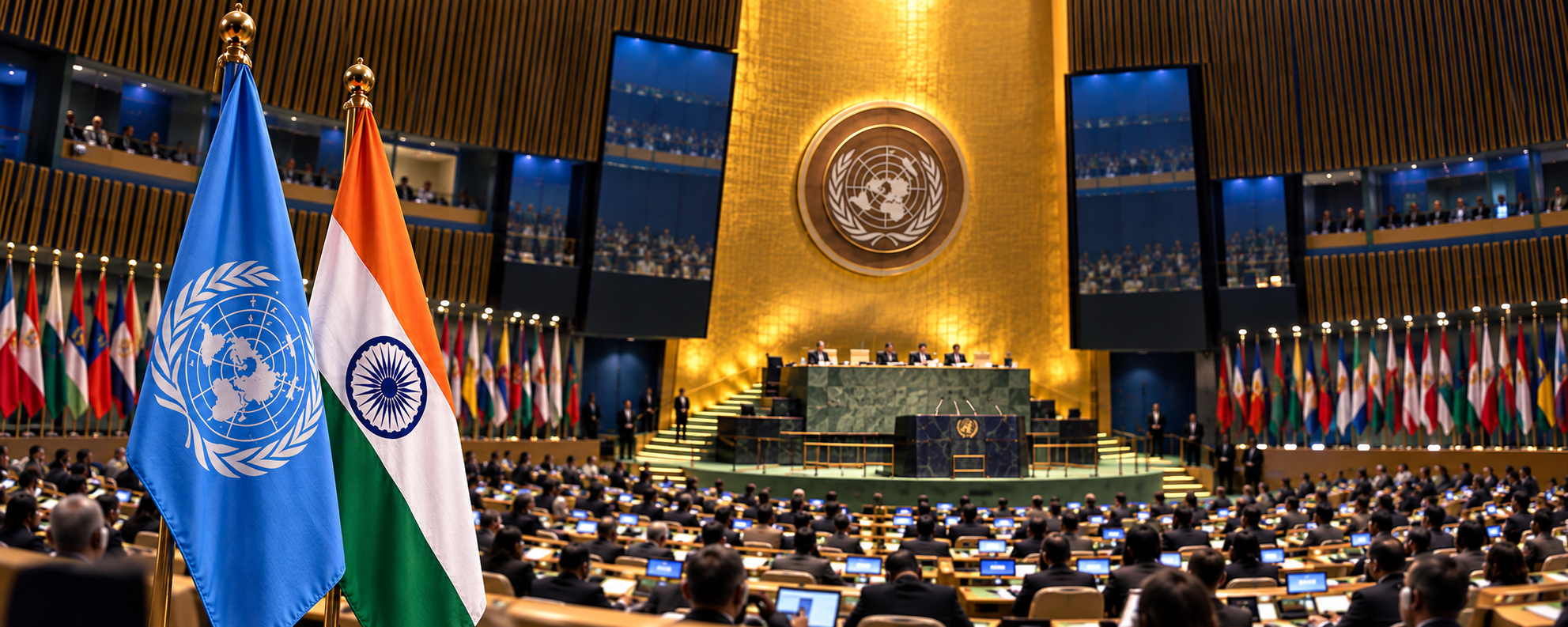
The general debate of the 81st United Nations General Assembly (UNGA) session concluded on 28 September 2026. As the international community navigates an increasingly complex global landscape, multilateral platforms remain essential for addressing transnational challenges. India’s engagement with these frameworks is deeply rooted. Having signed the UN Charter in June 1945 as one of its initial 51 members, India has since built a robust legacy of active participation. Marking a continuation of this steady diplomatic footprint, this session represented External Affairs Minister S. Jaishankar’s fifth consecutive year leading India’s delegation. Building upon its historical standing, including eight terms as a non-permanent Security Council member and extensive contributions to global peace, India utilized the 81st UNGA to advance its strategic priorities.
India formally launched its candidature for a non-permanent seat on the Security Council (UNSC) for the 2028-29 term on 13 July 2026. India continues to call for structural reform through the expansion of the Council in both the permanent and non-permanent categories, while seeking election to a non-permanent seat for 2028-29. This dual-track approach of seeking a near-term seat while advocating longer-term structural reform builds directly on India’s longstanding engagement with the UN system.
India’s Membership and Multilateral Engagement Since 1945
India signed the UN Charter in June 1945 as one of its initial 51 members. It has been elected by the General Assembly eight times to serve a two-year term as a non-permanent member of the Security Council, most recently in 2021-22. It has also engaged in multilateralism through counter-terrorism, climate frameworks and the G4 (Brazil, Germany, India and Japan). This institutional experience has given India both a record of participation in the UN system and a platform from which to argue that its present-day structures no longer reflect contemporary geopolitical realities.
Geopolitical Strain and Leadership Transition
The session convened amid heavy geopolitical strain, including the Russia-Ukraine conflict, the Israel-Gaza war and the months-long US-Israel war against Iran, whose disruption of the Strait of Hormuz has pushed up food and fuel costs across the Global South. Against the backdrop of a record 65 conflicts in 2025, the Secretariat faces a leadership transition as Secretary-General António Guterres’s term ends on 31 December 2026. Momentum is building behind candidates for the UN’s first woman Secretary-General, including Costa Rica’s Rebeca Grynspan and Guyana’s Carolyn Rodrigues Birkett. A leadership change at this level could reshape the Secretariat’s priorities in ways that affect how member states, including India, pursue reform and influence outcomes. These pressures have reinforced the case for a more representative and effective multilateral system, providing the broader context for India’s priorities at the 81st session.
India’s Priorities at the 81st Session
On the sidelines of the session, Jaishankar took part in an India–UAE–France trilateral meeting and a meeting of the G4 foreign ministers, which discussed reformed multilateralism and a more representative Security Council. India’s engagements covered four themes: Council reform with Global South solidarity; technology governance; development finance amid the “four Fs” crisis of fuel, food, fertiliser and finance; and India’s positions on Ukraine, the Gulf and counter-terrorism. Taken together, these engagements show that India’s multilateral agenda extends beyond Council reform to a broader effort to shape rules and institutions in areas affecting the Global South.
On technology, the AI Impact Summit held in New Delhi in February 2026, the first in its series hosted by a Global South country, produced the non-binding New Delhi Declaration on AI Impact, endorsed by 91 countries and international organisations. In his General Assembly address, Jaishankar referred to the Summit and said that AI would be part of India’s partnership agenda with the Global South. While no General Assembly decision on the Declaration has been reported yet, the UN’s own AI track continues separately. The Global Dialogue on AI Governance, launched by the General Assembly, held its inaugural meeting in July 2026, and its second session is scheduled for 3-4 May 2027 in New York.
Security Council Reform and Coalition Complexities
Council reform remains central to India’s multilateral agenda, yet structural obstacles persist. The Intergovernmental Negotiations (IGN) remain the only UN process without a formal negotiating text or deadline, and a Ministry of External Affairs briefing note conceded that the 80th session produced no concrete outcome. Without a negotiating text to rally around, India and the G4 must instead build consensus across loosely aligned coalitions. Beyond procedural delays, India and the G4 (Brazil, Germany, Japan) face massive diplomatic roadblocks: they must align their proposals with the L.69 Group (a coalition of developing nations pushing for broader representation) and the Africa Group, both of which share general reform goals but disagree fiercely on seat distribution and veto powers.
At the same time, they must fight off the “Coffee Club” (formally known as Uniting for Consensus), a rival bloc led by countries like Italy and Pakistan that completely opposes adding any new permanent seats. Meanwhile, the permanent five members of the UN Security Council are deeply divided: France and the UK support expansion, and the United States backs permanent seats for India, Germany, and Japan while withholding support for new veto powers. Because any change requires a grueling two-thirds General Assembly vote plus ratification by two-thirds of member states (including all five permanent members), India’s biggest challenge is building a massive, fragile coalition capable of bridging competing global ambitions. While recent backing from Russia offers a strategic boost, it simultaneously complicates the delicate diplomatic balancing act required to get everyone to agree.
Russia Supports Permanent Seats for India and Brazil
Russian Foreign Minister Sergey Lavrov’s 26 September 2026 General Assembly address highlighted a major diplomatic tightrope for New Delhi: while both the United States and Russia support India securing a permanent seat on the UN Security Council, they completely disagree on who else should join. The United States backs permanent seats for India alongside its G4 partners Germany and Japan, whereas Russia explicitly backs India alongside Brazil while firmly opposing the inclusion of countries like Germany and Japan. This creates a delicate balancing act for India, as its strongest strategic partners hold directly contradictory models of reform.
India’s Contribution to UN Peacekeeping
Alongside diplomatic advocacy, India has another source of credibility in the UN system: its longstanding contribution to peacekeeping. More than 290,000 personnel have served in over 50 peacekeeping missions since the 1950s. In a written reply to the Lok Sabha on 31 July 2026, the External Affairs Minister stated that about 4,200 Indian peacekeepers were then deployed in nine of the 11 active UN missions. In 2007, India fielded the UN’s first all-women Formed Police Unit in Liberia.
On women’s participation, India’s Permanent Representative told the Security Council’s open debate on Women, Peace and Security in June 2026 that more than 160 Indian women peacekeepers were serving in UN missions, including all-women Female Engagement Teams. The UN’s uniformed gender parity strategy sets a target of 15 percent women in military contingents by 2028. This record strengthens India’s argument that its claim to a greater role should be assessed not only in terms of geopolitical weight, but also through its practical contributions to the UN’s peace and security architecture.
India’s Engagement with the Global South and Voting Record
India uses the Assembly to convert Global South priorities into working frameworks. At the “Partners for Multilateralism” summit, it argued for coordinated AI risk governance and protected energy and food supply chains, working through the International Solar Alliance and the Global Biofuels Alliance.
On 24 February 2026, India abstained on “Support for Lasting Peace in Ukraine” (107 in favour, 12 against and 51 abstentions), alongside Brazil, China, South Africa and the United States. On the Gaza conflict, India had backed UN ceasefire resolutions in late 2023 and 2024, but shifted to an abstention in June 2025 on a resolution that ultimately passed with overwhelming support (149 countries voting in favor, 12 against, and others abstaining). New Delhi explained that while it remains deeply concerned by the humanitarian crisis, it abstained because the text lacked balanced accountability and direct diplomatic frameworks, maintaining that sustainable peace can only be achieved through direct dialogue and diplomacy.
India’s Right of Reply at the General Assembly
This combination of coalition-building, issue-based engagement and strategic autonomy was also visible in India’s exchanges with Pakistan during the General Assembly. India exercised its Right of Reply on 25 September after Pakistan raised Kashmir, the Indus Waters Treaty and claims regarding foreign mediation in its General Assembly address. First Secretary Petal Gahlot replied on behalf of India’s delegation. The Right of Reply is the procedure that allows a member state to respond to remarks made about it in the General Assembly. While procedurally routine, the exchange illustrates how bilateral disputes continue to intersect with India’s broader multilateral diplomacy.
Next Steps Through 2028
The next two years will test whether convening power yields outcomes. Three major milestones will shape this stretch. First, winning the well-contested June 2027 General Assembly election for the 2028-29 Security Council non-permanent seat against Tajikistan (which holds a vital Organisation of Islamic Cooperation endorsement, though India has secured early backing from key partners like the US, Austria, Sri Lanka, and Fiji); second, breaking decades of gridlock by forcing the Intergovernmental Negotiations (IGN) to finally adopt a formal, text-based negotiation document instead of endless open-ended talk; and third, successfully winning election seats across five other vital UN bodies to expand institutional footprint. Passing the June 2027 vote requires securing a demanding two-thirds majority of the General Assembly, making it a crucial test of whether a 1945-designed global architecture can accommodate a multipolar world.
India’s approach continues to rely on coalition-building, practical standard-setting and gradual integration. Whether an architecture designed in 1945 can accommodate a multipolar world remains the open question, with India’s campaign providing a useful test of that proposition.
References
United Nations, Department for General Assembly and Conference Management, “Heads of Permanent Missions to the United Nations.” https://www.un.org/dgacm/sites/www.un.org.dgacm/files/Documents_Protocol/headsofmissions.pdf
India Today, “S Jaishankar’s UNGA meetings: UN reform, AI, space, bilateral ties,” 23 September 2026. https://www.indiatoday.in/world/story/s-jaishankar-unga-meetings-un-reform-ai-space-bilateral-ties-ptag-3001228-2026-09-23
WION, “Jaishankar at UNGA: India pushes for reformed multilateralism, reforms to global institutions.” https://www.wionews.com/india-news/jaishankar-at-unga-india-pushes-for-reformed-multilateralism-reforms-to-global-institutions-1790046860281
India TV News, “Global order under stress: Jaishankar calls for stronger multilateralism at UNGA summit,” 22 September 2026. https://www.indiatvnews.com/news/world/global-order-under-stress-jaishankar-calls-for-stronger-multilateralism-at-unga-summit-2026-09-22-1054880
K.P. Nayar, “India’s UNGA story | From Rao-Vajpayee consensus to Modi-Jaishankar pattern,” Deccan Herald, 25 September 2026. https://www.deccanherald.com/opinion/indias-unga-story-from-rao-vajpayee-consensus-to-modi-jaishankar-pattern-4159181
Ministry of External Affairs, Government of India, “Visit of EAM Dr. S. Jaishankar to New York, USA for the High Level Week at the 81st Session of the United Nations General Assembly,” Press Release. https://www.mea.gov.in/press-releases?dtl/41809
Press Information Bureau, Government of India, document on India’s contribution to UN peacekeeping, March 2025. https://static.pib.gov.in/WriteReadData/specificdocs/documents/2025/mar/doc202539516101.pdf
All India Radio (newsonair), “India consistently supports UN in strengthening international peace and security: EAM in LS” (written reply of the External Affairs Minister, Lok Sabha), 31 July 2026. https://newsonair.gov.in/india-consistently-supports-un-in-strengthening-international-peace-and-security-eam-in-ls/
Zee News / ANI, “Global order under stress, multilateralism must assert itself strongly: Jaishankar at inaugural UNGA ‘Partners for Multilateralism’ Summit,” 22 September 2026. https://zeenews.india.com/india/global-order-under-stress-multilateralism-must-assert-itself-strongly-jaishankar-at-unga-summit-3072664.html
Dhruva Jaishankar and Medha Prasanna, “The Urgent Need for UN Security Council Reform,” ORF America, 2025. https://orfamerica.org/orf-america-comments/the-urgent-need-for-un-security-council-reform
Harsh V. Pant, “India’s UNSC moment,” Observer Research Foundation, 27 May 2026. https://www.orfonline.org/research/indias-unsc-moment
The Tribune, “India hits back at Pakistan at UN, says terrorism, ‘duplicity’ will have consequences,” 26 September 2026. https://www.tribuneindia.com/news/india/india-hits-back-at-pakistan-at-un-says-terrorism-duplicity-will-have-consequences/
Outlook India, “Who Is Petal Gahlot?,” September 2026 (Right of Reply, 25 September 2026). https://www.outlookindia.com/national/who-is-petal-gahlot-meet-the-indian-diplomat-who-took-on-pakistan-at-unga
Gateway House, “India bids for UNSC,” August 2026. https://www.gatewayhouse.in/india-bids-for-unsc/
StratNews Global, “India, Tajikistan Face Off in UNSC Race,” July 2026. https://stratnewsglobal.com/united-nations/india-tajikistan-face-off-in-unsc-race/
India’s World, “India’s Bid for a Non-Permanent UN Security Council Seat (2028-29): An Explainer,” July 2026. https://indiasworld.in/indias-bid-for-a-unsc-seat-2028-29-an-explainer/
Security Council Report, “First Security Council Straw Poll on UN Secretary-General Candidates,” July 2026. https://www.securitycouncilreport.org/whatsinblue/2026/07/first-security-council-straw-poll-on-un-secretary-general-candidates.php
1 for 8 Billion, “Straw Polls 2026.” https://1for8billion.org/straw-polls-2026
Business Today, “UNSC reform: Russia backs India’s seat bid, demands end to Western dominance,” 27 September 2026. https://www.businesstoday.in/india/story/unsc-reform-russia-backs-indias-seat-bid-demands-end-to-western-dominance-558078-2026-09-27
All India Radio (newsonair), “India-AI Impact Summit concludes with adoption of New Delhi Declaration,” 21 February 2026. https://www.newsonair.gov.in/india-ai-impact-summit-2026-adopts-new-delhi-declaration